Showing posts with label olive oil. Show all posts

2013-06-24

Summer Pilaf

I've just  rediscovered an old pilaf recipe of my mother, for hot summer days.

Ingredients

1 medium size onion
1 carrot
1 green pepper
1 celery stick
A handful of mushrooms
3 tbs of vegetable oil (best results with olive oil)
1 tbs balsamic vinegar
3-4 medium sized tomatoes
1/2 cup of rice (any rice will do but choose a healthier one, pre-boiled, whole grain rice)
Your favorite herbs and spices.  Mine pepper, allspice, laurel leaves, dill and parsley.

Preparation

Just blender or chop finely a medium size onion, a celery stick and a green pepper. Cut a carrot in fine slices. Stir fry the vegetables in 2 tbs of olive oil on medium heat for a couple of minutes. Add half a cup of rice (I've used a wonderful mixture of pre-boiled and all colors whole-grain rice) and a handful of finely diced mushrooms . Stir a couple of minutes more.
Add hot water (2 cups), a bit of salt  and let simmer until the rice is almost done (it depends on the rice but probably this takes no more than 20 minutes).

You can add also fried zucchini or eggplant cubes for a better taste. Cut zucchini or summer squash or eggplant into cubes, salt them and let them on a sieve for a quarter of an hour to drain. Fry them in a bit of oil slightly, just to change color. Add to the pilaf when the rice is almost ready.

Separately, boil 3-4 medium sized tomatoes, skinless and diced, with 1 Tbs olive oil, on medium heat for 5-10 minutes or until they  change color and loose some of the water. This will give a special taste to any pilaf or soup or sauce, believe me. 

Umami, the taste of parmesan cheesewink

When the rice is almost done, add the tomatoes to the pilaf. Add a spoon of balsamic vinegar.  Add your favorite spices and herbs.  I prefer pepper, allspice, laurel leaves, dill and parsley. Simmer it for a couple of minutes on low heat. Cut the heat and let it rest for half an hour.

You can store the summer pilaf in the fridge and eat it along the week as a main dish, side dish or snack. Excellent for No Meat days. It tastes best if cold and is so refreshing on a hot summer day. A bit of Parmesan or Swiss cheese will make it perfect. 

Enjoy!


2013-05-27

Fast Food in My Kitchen

Fast Food is my favorite food. No, you don't have problems with your eyes, that's what I've written.
But only if it's homemade.
My Fast Food is easy and quick to cook, very tasty, healthy, inexpensive and fills well.
No chemicals added, low salt, no sugar. If you aren't happy with gluten in your foot, you can have it without gluten.

Chinese like recipes

Some of my recipes are based on a couple of very simple Chinese recipes learned while in Beijing, China in 1984.

A few tools, some Chinese ingredients plus "mise en place" are essential for success.
The tools you need:
- a wooden cutting board and a good sharp knife to cut meat and vegetables.
- a wok or, at least, something shaped approximately like a wok. The bowl-shape is important because it helps you control the heat as you cook. Things toward the bottom will cook faster and hotter than things around the edges.
- a wooden spoon
- a watch
- a  few bowls

In French, "mise en place" means "everything in its place". It's very simple.
Before starting cooking fast food, have all tools and ingredients in front of you. Like in a TV cooking show.
Don't turn the fire on until every last ingredient is sliced, diced and ready to be thrown in.
Put the watch somewhere in front of your eyes.

Meal No 1 - Sauted Shredded Chicken


Ingredients for one portion
- oil (canola oil, peanut oil, sun flower oil or olive oil)
- optionally, half an egg white and a spoonful of rice flour or starch or cornstarch dissolved in a bit of water

MEAT
- chicken breast, no skin, no bones
VEGETABLES
- scallion
- garlic, 2-3 cloves

SAUCE
- a pinch of ginger powder or fresh ginger shredded
- half a cup with stock
- 2-3 spoons of white wine
- pinch of salt
- optionally, MSG, just a pinch

Step 1. Cut the meat into fine shreds (1 inch).
Step 2 (optional) Mix the egg white with the the starch in a bowl. Put the meat in and mix lightly.
Step 3. Shred the scallion into 1 inch pieces. The total volume of the scallion should equal the volume of chicken.
This means for each handful of chicken shreds you should have a handful of scallion.
Step 4. Mix the stock with the wine, salt and ginger. Add MSG, if you wish.
Step 5. In a wok, heat three spoons of oil over moderate heat. Be sure it's not hot otherwise the chicken will be too tough. Add the chicken and stir it lightly until the shreds are completely separate. This will take a couple of minutes. When just done (meat is becoming light brown), remove and drain. Set aside.
Step 6. Heat the wok and add a bit more oil. When hot, put in the garlic. Stir-fry until garlic starts to change color. Remove quickly the garlic.
Step 7. Put in the rest of the vegetables. Stir-fry lightly over high heat until they change color, but no more than 2 minutes!
Step 8. Add the stock mixture. Set the heat to low. Add the meat and stir lightly. Transfer to plate and serve.

Now here comes the best part of the story.
This dish can be varied substituting some of the ingredients. Also you can cut the meat and vegetables into squares, very fine slices, cubes, chunks, shreds, any shape as long as all are the same in size (around 1 inch).

Try these combinations

- MEAT:chicken breast, VEGETABLES:garlic sprouts, SAUCE: ginger, stock, white wine, salt, optionally MSG
- MEAT:chicken breast, VEGETABLES:mushrooms, garlic, SAUCE: soy sauce, stock
- MEAT:lean pork, VEGETABLES:red bell peppers,  SAUCE: chilli sauce

- MEAT:lean pork, VEGETABLES:eggplant , celery cut into 1 inch pieces, bell peppers cut into 1 inch squares, SAUCE: soy sauce and stock or a tomato sauce.
You have to prepare in advance the eggplant and add it at the very end, together with the meat.
Cut the eggplant into 1 inch cubes, spread with salt and leave it for  20 minutes, drain.
Stir-fry the eggplant over high heat in 3 spoons of oil,  remove from the wok, drain.
- MEAT:chicken breast, VEGETABLES:soy sprouts and/ or bamboo shoots, SAUCE: soy sauce, stock, optionally MSG
- If you're left with some yolk, add 1-2 more eggs, beat them well, make an omelette and when almost ready, add some soy sauce and simmer for a minute.

I call all these "The 7 Meals Recipe". You can have them for a nice lunch, dinner or even a party, with or without rice or pasta.


These recipes are excellent for South Beach Phase II and can be adapted for Phase I or gluten-free, if you skip Step 2.

More tips
My wok will never be in flames, I don't cook at high temperatures. I can't risk it, I know myself too well :)
This way, I can use safely olive oil for frying, for more flavor.
Read this article, for further information on frying with olive oil.
Dispelling the Myths of Frying with Olive Oil
http://www.oliveoiltimes.com/whats-cooking-with-olive-oil/frying-with-olive-oil/30470
Fried food 'fine for heart' if cooked with olive oil
http://www.bbc.co.uk/news/health-16691754

Fried potatoes

Well, what about fried potatoes? Fast Food without fried potatoes? Kids will cry, husband will protest etc...
Well, no fried old big potatoes for me but I sometimes cook them for my family. I prefer red (or pink?) potatoes and take care to use fresh sunflower oil each time.

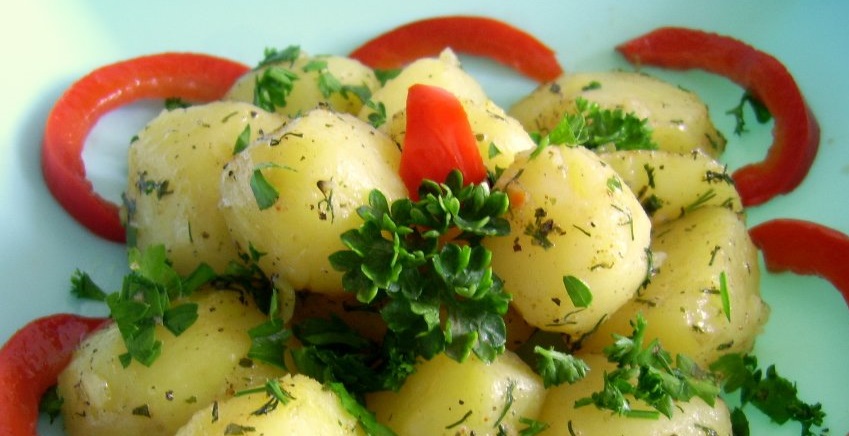
However, from April till June, we have the "new potatoes", small, fresh and delicious. Don't peel them!
I confess, I eat a handful of them,  boiled or fried, once or twice  a week. They don't have too much starch and glycemic load is low. To obtain even a lower glycemic load, I boil them 15-20 minutes and let them cool for 24 hours, before adding them to salads or frying them for 5 minutes.
Don't eat much, just a handful. Best eaten with yogurt and dill or parsley and a bit of garlic.

Of course they are not on the list for South Beach Phase II or I. But it's a traditional vegetable in my country, I've tried it and it hasn't affected my diet yet. On the contrary, best months so far for my diet seem to be May and June. However, if you don't live in Europe (European potatoes are less starchy) and you are on diet, you shouldn't eat potatoes. But you can cook my delicious Potato Salad for your family. Try to find a less starchy variety of potatoes.

Here is my New potato salad:

- 3-4 small new potatoes per person
- a handful of scallion, fine chopped
- a few spoons of olives
- 2-3 spoons olive oil
- 2-3 spoons balsamic vinegar
- your favorite herb, finely shredded. I like parsley.
- optionally, a handful of pickled mushrooms, pickled peppers, or a can of sardines or some marinated fish, shredded.
- optionally 1-2 hard boiled eggs

Put the small potatoes in hot salted water, over low heat. Don't peel them.  Let them boil for 15-20 minutes or until they are tender. Drain immediately and put in cold water for a couple of minutes.
Cut in slices and add the balsamic vinegar. Cover and let rest until lunch or dinner.
Or let them in the fridge for 24h, for a lower GL.
Put them in a large bowl and add the scallion, finely chopped, the olives, the olive oil. If you wish, add some pickled mushrooms or marinated fish or a can of sardines. Stir gently.
Decorate with parsley, red peppers and the hard boiled eggs.

Last but not least, you can't have a fast food menu without burgers. Keep in touch, I'll post more Fast Food healthy recipes.


2013-03-30

As Dear ... as Salt

Sparkling Salt from the Praid Salt MIne, Romania

A king once asked his daughter how dear he was to her.
"As dear, as dear -- as salt!" she said.
The king thought that this was very little, and he was very unhappy with his child's answer.
Soon thereafter he sponsored a great feast. The daughter saw to it that every dish was brought to the table unsalted, and thus nothing tasted good to the king.
Finally the daughter explained everything to him. He then recognized how important salt was...
(From an old German fairy tale)

I'm trying also to put some order in my mind. For a year or more I've been totally confused on the subject
"How much salt is safe".

First, the obvious. I'm citing from Wikipedia:
"Too much or too little salt in the diet can lead to muscle cramps, dizziness, or electrolyte disturbance, which can cause neurological problems, or even death.
Drinking too much water, with insufficient salt intake, puts a person at risk of water intoxication.
Death can occur by ingestion of large amounts of salt in a short time (about 1 g per kg of body weight). Deaths have resulted from attempted use of salt solutions as emetics."

Salt Mine Tools, Praid, Romania
Salt is essential for life and salt consumption is an instinct that drives a human or animal to seek and ingest salt-containing foods. The hunger for salt is also influenced by taste, traditions in cooking and preserving methods and the widespread availability of salt in industrial food.
To the point that it is difficult now to distinguish salt need from salt preference.

At some point in history, high salt consumption has been recognized as detrimental to health.

Research studies of salt effect on health fall in two categories. Many of them associate high intake of
salt to high blood pressure and increased rates of cardiovascular disease. But a lot others have found
flaws in their statistics and consider that there's no reason for healthy individuals to cut down their
salt intake. Especially that some studies used mice models.
However, in national studies in Finland, instituting a national salt-reduction program led to decreased sodium intake. The resulting decrease in systolic and diastolic blood pressures corresponded to a 75 -- 80 percent decrease in death due to stroke and coronary heart disease.
You simply can't ignore such data.
A new article in The New England Journal of Medecine,  Salt in Health and Disease — A Delicate Balance
provides an overview of the current understanding of the relation of salt consumption to hypertension and
cardiovascular disease. If you can deal with medical terms, it's an interesting reading.

In terms of safety, the lower and higher limits of salt consumption have not been clearly identified.
There is an ongoing controversy, all parties shooting so many arguments and really, is difficult for me, at least, to trust any figures anymore.
When science is in doubt, I turn to my own experience and keep fingers crossed.
A very low-salt diet (less than 1500 mg) is almost impossible in a modern diet.
It's not feasible. Even a diet with less than 2000 mg of salt daily is quite difficult to follow, especially in winter.
There's no danger in fact of too low salt intake unless you have a diet of milk and fruits only, which no nutrition guru would recommend for a normal diet.

What about reducing salt when you are healthy, wealthy or not, wise or maybe not?
If you give up junk food and limit processed meat, which every doctor, nutritionist, health organization
in the world recommends, you are reducing quite a lot the salt in your diet.
But I guess whatever the science says, most people will eat as much salt as desired unless maybe at some point in life a doctor will say "stop this or you'll die".

Too much salt in your food can cause edema (swelling due to fluid retention). This is easy to notice.
If eating too much salty food in a day causes your ankles or joints to swell, then you have but one solution. Hide the salt shaker, add less salt to your food, limit consumption of processed meat and pickles. Generally, start reducing salt. How much? Obvious, to the point you won't notice edema symptoms.

What about hypertension? Should you reduce salt and how much?
When it comes to hypertension, reducing salt is a must.
In clinical trials, a reduction in salt intake is associated with reduced blood pressure, more so in
persons with hypertension than in those with normal blood pressure.
Reduced salt intake is associated with greater blood-pressure responses to anti hypertensive drug therapy,
including drug therapy in patients with resistant hypertension.

Whether you're healthy or have medical problems, there are studies that say that it's also important to increase potassium in your diet to counteract salt effects.
This is not at all difficult if you include beans, potatoes, nuts, oranges, mushrooms, tomatoes a.s.o. in your menu.
In my case, a diet with less cereals and starch (somewhat between a South Beach Diet and the Mediterranean Diet),   salt reduction (between 1600 - 2000 mg daily), increase of potassium rich food (around 4000 mg a day) and exercising a lot more resulted in the reduction of hypertension drugs need and generally less health problems.


However, in summer and when exercising a lot, I take care to drink mineral water  and eat a bit more salty.
Don't wait to become thirsty to drink water but, especially  when it's very hot outside, drinking too much water and eating less salt it's a recipe for feeling dizzy.

A bowl of tomatoes, peppers, cucumbers, onion, parsley salad with olive oil, bit of lemon juice or vinegar, a few olives  and bits of white cheese is the best summer salad recipe.

The famous Greek or Bulgarian or Romanian Tomato Salad or by any other name is healthy, tasty and so easy to make.


I guess, with salt, as with anything good in our life, the key is in moderation.


Tip. When in Romania, visit Salina Praid, one of the biggest salt mine in Romania.